
Is Cholesterol Really the Cause of Heart Disease? Understanding the Debate and What Matters for Long-Term Risk
4/3/20264 min read
Why this question keeps coming up
If you have been reading about cholesterol online, you may have come across claims that cholesterol is not the true cause of heart disease. Some books, including The Great Cholesterol Con, suggest that cholesterol has been wrongly blamed and that factors such as stress or inflammation are more important.
It is therefore completely understandable that many people feel confused. On the one hand, you may have been advised to lower your cholesterol. On the other, you may have read that cholesterol does not matter at all.
The truth, as is often the case in medicine, sits somewhere in between oversimplified messages.
What these arguments get right
It is important to say at the outset that not all of these alternative viewpoints are incorrect. In fact, some of the criticisms raised are valid and reflect how our understanding of heart disease has evolved.
Heart disease is not caused by a single number on a blood test. It is a complex process influenced by multiple factors including inflammation, blood pressure, metabolic health, and lifestyle.
It is also true that cholesterol itself is a vital molecule. It plays an essential role in cell membranes, hormone production, and vitamin D synthesis. Most cells in the body can produce their own cholesterol, which highlights how fundamental it is to normal physiology.
In addition, traditional messaging around “good” and “bad” cholesterol has been overly simplistic. This has understandably led to confusion and, at times, mistrus
What these arguments get right
It is important to say at the outset that not all of these alternative viewpoints are incorrect. In fact, some of the criticisms raised are valid and reflect how our understanding of heart disease has evolved.
Heart disease is not caused by a single number on a blood test. It is a complex process influenced by multiple factors including inflammation, blood pressure, metabolic health, and lifestyle.
It is also true that cholesterol itself is a vital molecule. It plays an essential role in cell membranes, hormone production, and vitamin D synthesis. Most cells in the body can produce their own cholesterol, which highlights how fundamental it is to normal physiology.
In addition, traditional messaging around “good” and “bad” cholesterol has been overly simplistic. This has understandably led to confusion and, at times, mistrus
Where the evidence is clear
Despite these valid points, the idea that cholesterol is not involved in heart disease does not reflect the full body of scientific evidence.
What matters is not cholesterol in isolation, but how it is transported in the bloodstream.
Cholesterol is carried within particles known as lipoproteins. Of particular importance are particles that contain a protein called ApoB. These include LDL and other atherogenic lipoproteins.
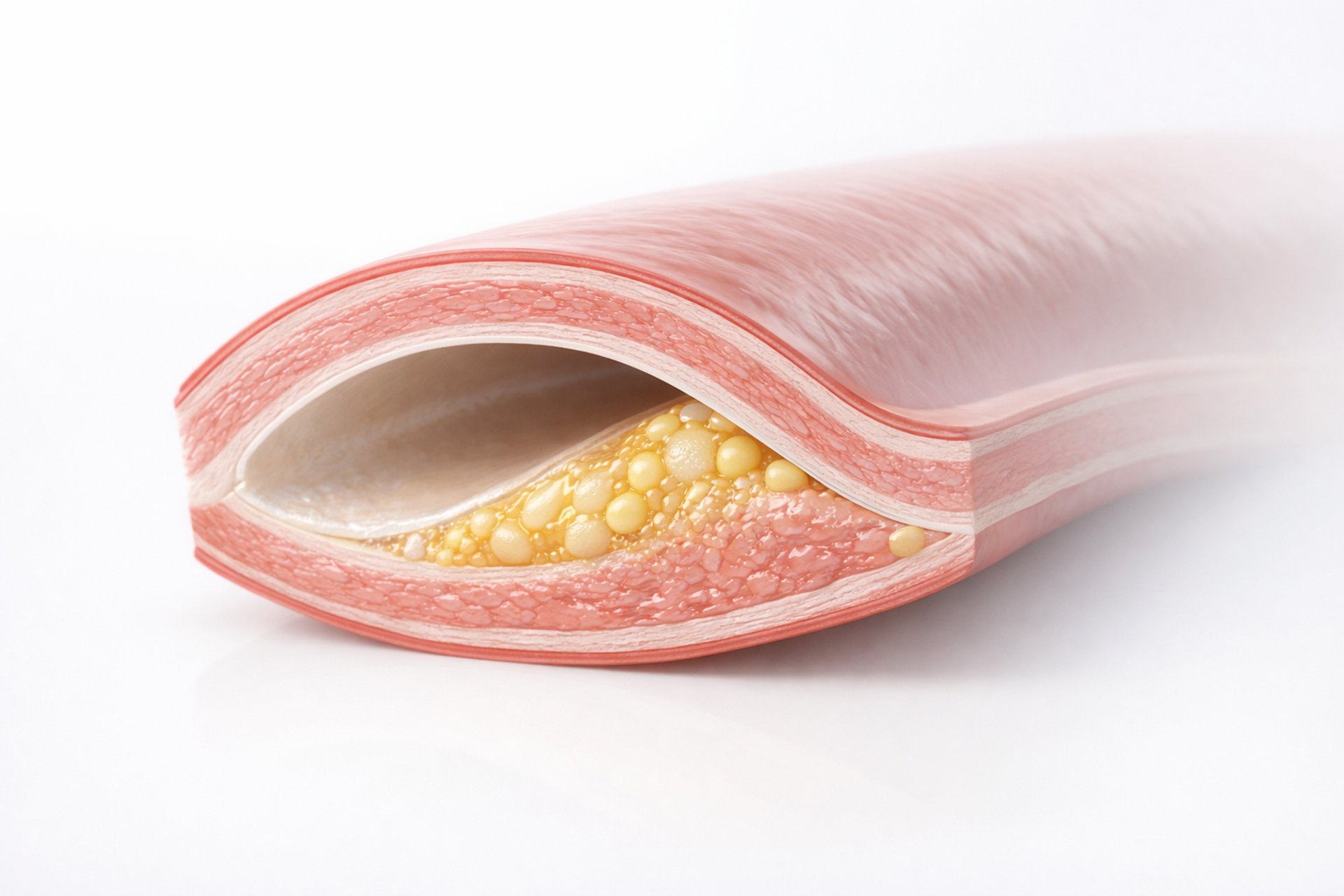
These ApoB-containing particles can enter the artery wall, where they become trapped and trigger inflammation. Over time, this process leads to the development of atherosclerotic plaque — the underlying cause of heart attacks and strokes.
Crucially, this is not just an association. Multiple lines of evidence, including genetic studies and large clinical trials, demonstrate that reducing the number of these particles lowers the risk of cardiovascular events.
Another important concept is cumulative exposure. The longer the arteries are exposed to elevated levels of ApoB-containing particles, the greater the lifetime risk. This helps explain why some individuals develop heart disease at a young age, particularly in inherited conditions such as familial hypercholesterolaemia.
Why the story became oversimplified
Part of the confusion arises from how cholesterol has been communicated historically.
Public health messaging has often reduced a complex biological system into simple categories such as “good” and “bad” cholesterol. While this may have been intended to make information more accessible, it has also obscured important detail.
At the same time, earlier research focused heavily on total cholesterol and dietary fat, without fully understanding the role of lipoprotein particles, inflammation, and metabolic health.
As a result, some of the criticism you may encounter today is actually a response to an outdated version of the science, rather than the current understanding.
The modern understanding
We now have a far more refined view of cardiovascular disease.
A useful way to think about it is that heart disease develops when cholesterol-containing particles interact with the artery wall over many years, within a broader environment influenced by inflammation and metabolic health.
In simple terms, ApoB-containing particles are necessary for plaque formation, but they are not the only factor. Blood pressure, smoking, diabetes, and other conditions all influence how the disease progresses.
This more integrated model allows us to move beyond simplistic explanations and towards personalised risk assessment.
What this means for you
For patients, the most important takeaway is that risk is individual.
Not everyone with a mildly raised cholesterol level requires medication. Equally, some individuals with seemingly modest results may be at significantly higher risk due to underlying factors such as genetics or metabolic health.
The goal is not simply to treat a number, but to understand what is driving your risk and address it in a targeted and evidence-based way.
For some people, lifestyle measures will be sufficient. For others, medication plays an important role in reducing long-term risk. These decisions should always be made in the context of the whole clinical picture.
What this means for you
For patients, the most important takeaway is that risk is individual.
Not everyone with a mildly raised cholesterol level requires medication. Equally, some individuals with seemingly modest results may be at significantly higher risk due to underlying factors such as genetics or metabolic health.
The goal is not simply to treat a number, but to understand what is driving your risk and address it in a targeted and evidence-based way.
For some people, lifestyle measures will be sufficient. For others, medication plays an important role in reducing long-term risk. These decisions should always be made in the context of the whole clinical picture.
Final thoughts
The idea that cholesterol is irrelevant to heart disease is appealing in its simplicity, but it does not reflect the reality of modern evidence.
Cholesterol is not the whole story — but it remains one of the most important parts of it.
Understanding how it fits into your individual risk is the key to making informed decisions about your long-term health.
Contact
GMC Registered | NHS Consultant Endocrinologist
For Patients
© 2026. All rights reserved.
For Healthcare Professionals

